
The Business Rule Completeness Conjecture
And what it means to be BRCC Complete.

The Business Rule Completeness Conjecture
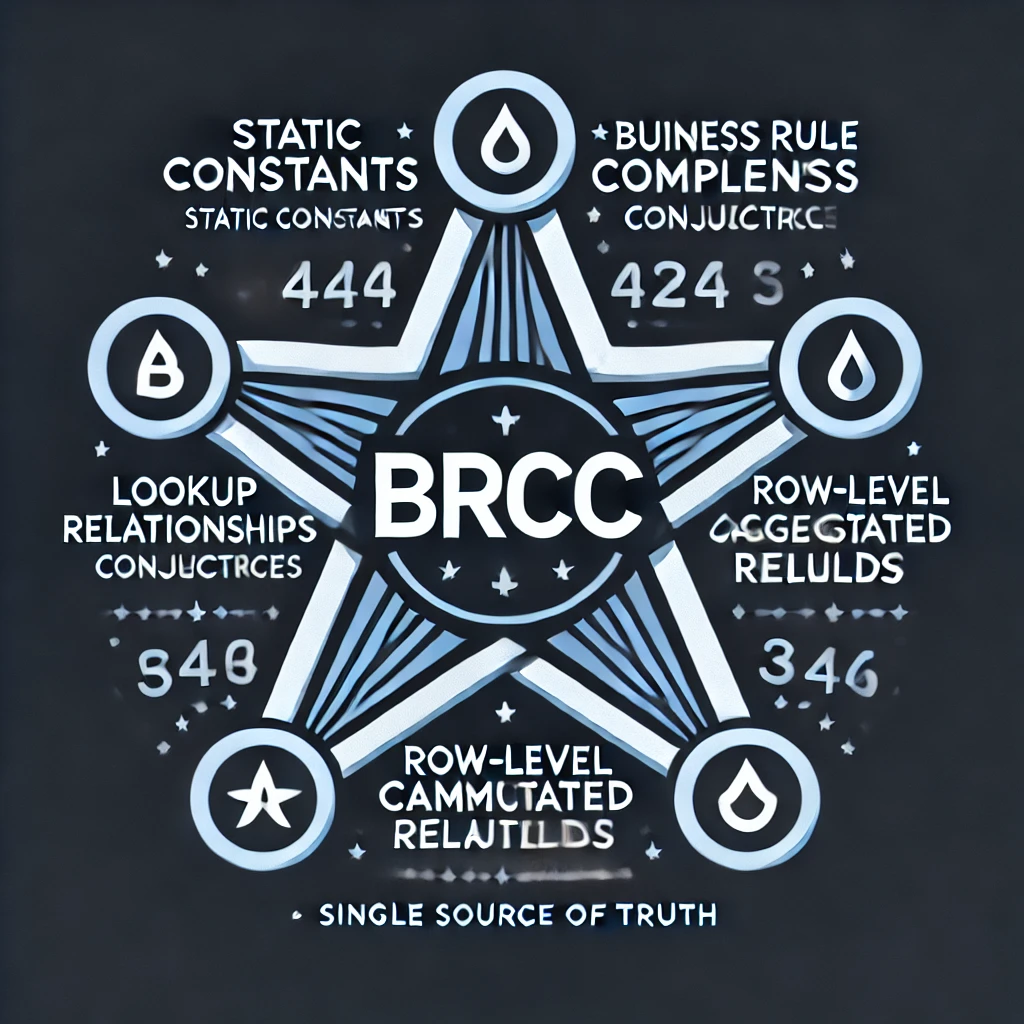
The Business Rule Completeness Conjecture (BRCC), formulated by EJ Alexandra, asserts that all business rules and conceptual models can be fully expressed using five core primitives, entirely independent of any specific syntax. It challenges the traditional reliance on language-specific syntax and proposes a syntax-free conceptual framework for capturing meaning. Here’s a summary:
The Five Core Primitives
-
Static Constants: Fixed, unchanging data (e.g., product categories, country codes).
-
Lookup Relationships: References between records, such as parent/child hierarchies (e.g., an order referencing its customer).
-
Aggregation Relationships: Summaries or calculations over related data (e.g., summing line items on an invoice).
-
Row-Level Calculated Fields: Formulas that compute values (e.g., total price = quantity × unit price).
-
ACID-Compliant Single Source of Truth: A centralized, consistent environment ensuring all data and rules are in sync.
Key Insights
-
Declarative vs. Procedural: BRCC emphasizes separating the declarative "what" from the imperative "how", treating syntax as a downstream artifact rather than the core of system design.
-
Cross-Platform Fidelity: Knowledge defined in these primitives can seamlessly migrate between platforms like Airtable, Baserow, SQL Server, and MySQL, without loss of semantic meaning.
-
Empirical Validation: Experiments (e.g., the “Telephone Game” with LLMs) showed lower semantic drift with syntax-free models compared to syntax-locked approaches.
Implications
-
Reduced Complexity: Centralizing semantics eliminates drift and manual rewriting across languages or systems.
-
Scalability: Future-proof systems adapt to new tools or platforms without significant rework.
-
Seamless Collaboration: Unified conceptual models simplify interdepartmental and cross-system integration.
Real-World Application
Airtable and Baserow exemplify BRCC-compliant environments by natively supporting all five primitives, allowing direct modeling of reality without the intermediate complexity of syntax-heavy paradigms. This ensures semantic fidelity and easy translation across platforms.
BRCC envisions a shift in software engineering and knowledge representation, moving from monolithic, syntax-locked codebases to flexible, declarative, and syntax-free foundations.
The Business Rule Completeness Conjecture (BRCC)
Eliminating the “Ripple Effect” in Model Evolution
EJ Alexandra
start@anabstractlevel.com
SSoT.me & EffortlessAPI.com
January 2025
“Because once you see it, you can’t unsee it!”
Table of Contents
[Abstract 2](https://docs.google.com/document/d/1VdHIIoDVlZN9Fx54jvCmAiGP9aSDtNJtXVY8Z7mGMYk/edit?tab=t.0# heading=h.v67gyap6zvom)
[1. Introduction: A Paradigm Shift 2](https://docs.google.com/document/d/1VdHIIoDVlZN9Fx54jvCmAiGP9aSDtNJtXVY8Z7mGMYk/edit?tab=t.0# heading=h.ta6q4rfyldp)
[1.1 Why This Conjecture Matters 2](https://docs.google.com/document/d/1VdHIIoDVlZN9Fx54jvCmAiGP9aSDtNJtXVY8Z7mGMYk/edit?tab=t.0# heading=h.u63g797s2a5p)
[2. Related Work and Positioning 2](https://docs.google.com/document/d/1VdHIIoDVlZN9Fx54jvCmAiGP9aSDtNJtXVY8Z7mGMYk/edit?tab=t.0# heading=h.ymdlu65k3t7z)
[2.1 Model-Driven Engineering (MDE) and Co-Evolution 3](https://docs.google.com/document/d/1VdHIIoDVlZN9Fx54jvCmAiGP9aSDtNJtXVY8Z7mGMYk/edit?tab=t.0# heading=h.kro3vc9irry7)
[2.2 Turing-Completeness in Databases 3](https://docs.google.com/document/d/1VdHIIoDVlZN9Fx54jvCmAiGP9aSDtNJtXVY8Z7mGMYk/edit?tab=t.0# heading=h.j6566fq4anjq)
[2.3 The Necessity (or Myth) of Syntax 3](https://docs.google.com/document/d/1VdHIIoDVlZN9Fx54jvCmAiGP9aSDtNJtXVY8Z7mGMYk/edit?tab=t.0# heading=h.sj5rmvrhey5t)
[3. The Business Rule Completeness Conjecture 3](https://docs.google.com/document/d/1VdHIIoDVlZN9Fx54jvCmAiGP9aSDtNJtXVY8Z7mGMYk/edit?tab=t.0# heading=h.5odwwuj4jpsn)
[3.1 The Core Statement 3](https://docs.google.com/document/d/1VdHIIoDVlZN9Fx54jvCmAiGP9aSDtNJtXVY8Z7mGMYk/edit?tab=t.0# heading=h.98tmprlhny54)
[3.2 Separation of Concerns (Design-Time vs. Runtime) 4](https://docs.google.com/document/d/1VdHIIoDVlZN9Fx54jvCmAiGP9aSDtNJtXVY8Z7mGMYk/edit?tab=t.0# heading=h.ecpbg9qi1ron)
[3.3 Falsifiability 4](https://docs.google.com/document/d/1VdHIIoDVlZN9Fx54jvCmAiGP9aSDtNJtXVY8Z7mGMYk/edit?tab=t.0# heading=h.56f43aapdipq)
[4. Eliminating the Ripple Effect: How BRCC Resolves MDE’s Biggest Pain 4](https://docs.google.com/document/d/1VdHIIoDVlZN9Fx54jvCmAiGP9aSDtNJtXVY8Z7mGMYk/edit?tab=t.0# heading=h.w34lxurpgims)
[4.1 Model Co-Evolution 4](https://docs.google.com/document/d/1VdHIIoDVlZN9Fx54jvCmAiGP9aSDtNJtXVY8Z7mGMYk/edit?tab=t.0# heading=h.99be0uraws5i)
[4.2 Model Repair 5](https://docs.google.com/document/d/1VdHIIoDVlZN9Fx54jvCmAiGP9aSDtNJtXVY8Z7mGMYk/edit?tab=t.0# heading=h.a6ntpuoyis9j)
[4.3 Portable and Generic Transformations 5](https://docs.google.com/document/d/1VdHIIoDVlZN9Fx54jvCmAiGP9aSDtNJtXVY8Z7mGMYk/edit?tab=t.0# heading=h.jq3elk73nnbf)
[4.4 Mindset Shift 5](https://docs.google.com/document/d/1VdHIIoDVlZN9Fx54jvCmAiGP9aSDtNJtXVY8Z7mGMYk/edit?tab=t.0# heading=h.ej251llv9ix2)
[5. Empirical Evidence: Attempts to Falsify BRCC 5](https://docs.google.com/document/d/1VdHIIoDVlZN9Fx54jvCmAiGP9aSDtNJtXVY8Z7mGMYk/edit?tab=t.0# heading=h.wt8czpnljvh5)
[5.1 LLM “Telephone Game” Experiment 5](https://docs.google.com/document/d/1VdHIIoDVlZN9Fx54jvCmAiGP9aSDtNJtXVY8Z7mGMYk/edit?tab=t.0# heading=h.5j3459bzwra1)
[5.2 Real-World Deployments 5](https://docs.google.com/document/d/1VdHIIoDVlZN9Fx54jvCmAiGP9aSDtNJtXVY8Z7mGMYk/edit?tab=t.0# heading=h.gbvyl4ahuobw)
[5.3 Illustrative Example 5](https://docs.google.com/document/d/1VdHIIoDVlZN9Fx54jvCmAiGP9aSDtNJtXVY8Z7mGMYk/edit?tab=t.0# heading=h.alox4eg7sxpt)
[6. How to Falsify BRCC 6](https://docs.google.com/document/d/1VdHIIoDVlZN9Fx54jvCmAiGP9aSDtNJtXVY8Z7mGMYk/edit?tab=t.0# heading=h.7qv5zse0mlqa)
[7. Broader Implications and Future Work 6](https://docs.google.com/document/d/1VdHIIoDVlZN9Fx54jvCmAiGP9aSDtNJtXVY8Z7mGMYk/edit?tab=t.0# heading=h.jmhry9rp2pik)
[7.1 Rethinking MDE 6](https://docs.google.com/document/d/1VdHIIoDVlZN9Fx54jvCmAiGP9aSDtNJtXVY8Z7mGMYk/edit?tab=t.0# heading=h.br8oualxkptf)
[7.2 Extending to New Paradigms 6](https://docs.google.com/document/d/1VdHIIoDVlZN9Fx54jvCmAiGP9aSDtNJtXVY8Z7mGMYk/edit?tab=t.0# heading=h.nyyldm6o8pfi)
[7.3 Potential Limitations 6](https://docs.google.com/document/d/1VdHIIoDVlZN9Fx54jvCmAiGP9aSDtNJtXVY8Z7mGMYk/edit?tab=t.0# heading=h.ycdd5mk10lo2)
[8. Conclusion: Once You See It, You Cannot Unsee It 7](https://docs.google.com/document/d/1VdHIIoDVlZN9Fx54jvCmAiGP9aSDtNJtXVY8Z7mGMYk/edit?tab=t.0# heading=h.5dicd4418sei)
[9. References 8](https://docs.google.com/document/d/1VdHIIoDVlZN9Fx54jvCmAiGP9aSDtNJtXVY8Z7mGMYk/edit?tab=t.0# heading=h.p3v1hvp7s2hv)
10. [Acknowledgments 8](https://docs.google.com/document/d/1VdHIIoDVlZN9Fx54jvCmAiGP9aSDtNJtXVY8Z7mGMYk/edit?tab=t.0# heading=h.dm0qbu40snbp)
11. [Note on Supplementary Addenda 9](https://docs.google.com/document/d/1VdHIIoDVlZN9Fx54jvCmAiGP9aSDtNJtXVY8Z7mGMYk/edit?tab=t.0# heading=h.21zpnwo02vb8)
Abstract
The Business Rule Completeness Conjecture (BRCC) asserts that **the declarative, design-time semantics for any finite business rule can be decomposed—entirely and unambiguously—using only five declarative primitives: Schema, Data, Lookups, Aggregations, and Lambda Calculated Fields in an ACID-compliant environment. **These fields employ lambda expressions to perform calculations, providing flexibility and power across various applications. This rulebook (the what) is explicitly decoupled from the runtime engine (the how) of code execution. By conceptualizing every domain concept in a multi-dimensional, syntax-free form (treating time as just another dimension), BRCC aims to eliminate the pervasive “ripple effect” that plagues model evolution whenever rules change. The Conjecture is falsifiable: one must find a business rule expressible in natural language and traditional, imperative code that cannot be represented by these five primitives in an ACID datastore. Over decades of real-world practice—and extensive AI-based 'falsification attempts'—no such counterexample has emerged. We invite the community to provide further challenges to test and refine BRCC, seeking contributions that either support or contradict our findings.
1. Introduction: A Paradigm Shift
The typical approach to defining business logic involves scattering rules across code, spreadsheets, DSLs, or textual specifications. This inevitably leads to syntax-locking—linear textual forms that cause interpretive ambiguities and drift over time. Model-Driven Engineering (MDE) partially addresses this complexity by employing metamodels (M2), instance models (M1), and transformations (M2 → M1 → code). Yet, every metamodel change triggers an alignment cascade—commonly called the “ripple effect”—which many practitioners regard as unavoidable.
BRCC directly challenges that assumption. It states:
BRCC: Any finite business rule (including time-based logic) can be captured using five primitives—(S, D, L, A, F) in a single ACID-compliant datastore—without resorting to syntax at design time.
By drawing a clear distinction between the “rulebook” (design-time what) and the “runtime” (execution-time how), BRCC removes the typical transformations that plague evolving systems. Once implemented, it becomes evident that the ripple effect is not a necessary evil; rather, it is a byproduct of conventional, syntax-based processes.
1.1 Why This Conjecture Matters
-
Eliminates the “Ripple Effect”: By defining all domain semantics in an ACID-protected environment, metamodel changes are instantly reflected in the model—no separate transformers or “repair” steps are required.
-
Domain-Agnostic & Generic: These five primitives apply to any domain, enabling easy portability of entire M3–M0 semantics across different runtimes or storage layers.
-
Falsifiability: BRCC issues a direct challenge: produce a single business rule that cannot be expressed in (S, D, L, A, F), and the conjecture collapses.
2. Related Work and Positioning
2.1 Model-Driven Engineering (MDE) and Co-Evolution
Metamodel–Model (M2–M1) Coevolution: In traditional MDE, changes to the metamodel (M2) typically require domain-specific transformations and code regeneration. Modifications cascade into M1 and M0, forcing repeated rework.
BRCC: By contrast, in a BRCC-compliant environment, M2 and M1 share the same underlying structure, removing the need for specialized coevolution or alignment. The “puddle and hole” analogy clarifies that the metamodel (the hole) and the model (the puddle) inherently fit by design.
2.2 Turing-Completeness in Databases
Relational databases are known to be Turing-complete at runtime (via recursion or stored procedures). BRCC extends this notion to design time, insisting on an ACID environment for storing all rules so that domain semantics remain cohesive prior to execution or code generation.
Bold Clarification: Because many database platforms (e.g., Airtable, Baserow, traditional RDBMS) can theoretically encode arbitrarily complex logic, the “finite” business rule boundary seldom becomes a strict limitation in practice. In more sophisticated logic scenarios, the same Turing-complete foundation applies at runtime. The important point is that any finite, computable logic expressible in typical textual code can also be modeled declaratively in an ACID store.
2.3 The Necessity (or Myth) of Syntax
Linguistic studies show how linear text can lead to interpretation drift (Chomsky, 1965; Whorf, 1956). BRCC argues that this drift does not inherently result from specifying rules—it arises because we adhere to line-by-line textual forms. The Conjecture aims to eliminate that root cause.
Syntax-Free vs. Syntax-Locked
-
Syntax-Free: A hyper-dimensional representation that directly mirrors the conceptual model (reality) in a bijective way. Because it resides in an ACID datastore, no domain-specific language (DSL) or line-by-line code is needed at design time.
-
Syntax-Locked: A linear (one-dimensional) sequence of symbols and statements—i.e., traditional textual code or a DSL—that must conform to an abstract syntax. These artifacts describe the conceptual model, rather than directly mirroring it.
In BRCC terms, “syntax-free” does not imply “no structure at all.” Instead, it indicates that domain semantics are captured in declarative primitives (S, D, L, A, F) without binding the design-time rules to a specific textual or imperative syntax.
3. The Business Rule Completeness Conjecture
3.1 The Core Statement
Any finite, computable business rule—time-based or otherwise—can be specified using exactly five declarative primitives (S, D, L, A, F) in a single ACID-compliant datastore, without requiring design-time syntax.
-
Schema (S): The structure or “shape” of entities and relationships (e.g., tables, columns, constraints).
-
Data (D): The instances or records of those entities (rows in tables), including historical or time-based entries.
-
Lookups (L): Parent relationships or foreign keys that define relational context among records.
-
Aggregations (A): Summaries or roll-ups across sets of records (e.g., sums, counts, means), all defined declaratively.
-
Lambda Calculated Fields (F): Declarative expressions that compute new values from existing fields or aggregates.
Time is treated as just another dimension (e.g., “EffectiveDate”) so that no specialized temporal logic syntax is needed at design time.
Note on Complexity: While it is technically possible to encode the “how-to” of lower-level tasks (e.g., SMTP emailing) within these primitives, BRCC is chiefly about capturing the business semantics—“under what conditions an email should be sent”—while leaving the runtime engine free to implement these tasks in any language or framework.
3.2 Separation of Concerns (Design-Time vs. Runtime)
-
Rulebook (Design-Time): The specification in (S, D, L, A, F). All domain semantics remain purely declarative and enforced via ACID.
-
Execution Engine (Runtime): The how—whether microservices, compiled code, or stored procedures. BRCC does not dictate how rules execute, only how they are stored and maintained.
Practical Tooling:
Examples include “baserow-to-python” or “airtable-to-dotnet,” generating bespoke SDKs or code from the same BRCC-compliant model. These code artifacts all align because they are not the ultimate source—only projections from a single ACID rulebook.
3.3 Falsifiability
To disprove BRCC, present one business rule (in English, DSL, or code) that cannot be represented using these five primitives in an ACID datastore. Despite decades of attempts and recent LLM-based challenges, no such rule has been found.
- Finite, Computable Boundaries: We assume the rule is finite and computable (expressible in natural language or code that halts). Non-computable or infinitely recursive rules fall outside typical business contexts. For any finite rule that can be written in a conventional programming language, BRCC claims it can be represented in (S, D, L, A, F).
4. Eliminating the Ripple Effect: How BRCC Resolves MDE’s Biggest Pain
4.1 Model Co-Evolution
In traditional MDE, changes to the metamodel (M2) often require re-generating or fixing M1 artifacts (model repair). Under BRCC:
-
ACID Constraint: The metamodel (M2) and model (M1) remain consistent by design.
-
Shared Shape: Changes to M2 automatically flow into M1, as both are housed in the same schema rather than separate textual artifacts.
4.2 Model Repair
Because the system is always in a valid state (thanks to ACID’s atomic transactions), there is minimal need for “repair.” A minor structural adjustment at M2 is immediately reflected in M1—much like reshaping a container that the “data puddle” naturally refills.
4.3 Portable and Generic Transformations
Since the five primitives are domain-agnostic, the entire rulebook can move seamlessly across environments—SQL, NoSQL, knowledge-graph—without losing fidelity. Transformations for CI/CD become simpler: domain changes are recognized immediately in production.
In practice, tools like “draw-io-to-statemachine-json” or “statemachine-json-to-docs” show how BRCC-complete models can be projected into specialized runtimes without deviating from the single source of truth.
4.4 Mindset Shift
Crucially, many teams believe that friction in evolving systems is inevitable. BRCC contends this friction arises only because rules remain “locked” in text-based DSLs or code. A fully declarative, design-time ACID environment circumvents that lock, dramatically reducing complexity over time.
5. Empirical Evidence: Attempts to Falsify BRCC
5.1 LLM “Telephone Game” Experiment
We tested iterative transformations of requirements in two formats: one purely textual (“Syntax-Locked”), another in a JSON-like or structured format (“Syntax-Free”). LLM-based transformations tended to drift substantially for the textual set, while the structured set remained nearly identical. This underscores BRCC’s assertion that multi-dimensional, syntax-free definitions resist accidental evolution and interpretative ambiguity.
5.2 Real-World Deployments
Although BRCC has not been formally tested in every domain (e.g., finance, healthcare), extensive experience—spanning decades in developing state regulatory software, live streaming, and web conferencing—has never yielded a counterexample. Moreover, discussions with a broad set of professionals, plus AI-based attempts to break the conjecture, have uncovered no failures across multiple industries.
Notably, Airtable and Baserow—both fully ACID-compliant at design time—exhibit “BRCC completeness.” Millions of user-created “bases” cover a diverse range of business needs (marketing flows, project tracking, scheduling) without demanding specialized textual or imperative logic. While not a formal proof, such widespread usage demonstrates the feasibility of storing even complex business rules with minimal friction.
5.3 Illustrative Example
Consider a simple declarative rule to mark a customer for follow-up based on trial status:
-
Schema (S): A “Customer” table with fields such as TrialEndDate and SubscriptionStatus.
-
Data (D): Customer rows, each with actual TrialEndDate values.
-
Lookups (L): A reference (foreign key) to SubscriptionStatus or EmailTemplates.
-
Aggregations (A): (Optional) Summaries of days since trial start or number of overdue tasks.
Lambda Calculated Fields ** (F)**:
NeedsEmail = (Today >= TrialEndDate)
AND (SubscriptionStatus != 'Upgraded')
Design-Time: The requirement “when a customer needs an email” lives purely declaratively in the ACID-compliant model.
Runtime: Any chosen engine evaluates NeedsEmail and sends the message accordingly. No separate imperative code or DSL modifications are required.
6. How to Falsify BRCC
We invite formal challenges to BRCC:
-
State the Rule: Provide a finite, computable business rule in plain English or an imperative programming language.
-
Attempt the Decomposition: Demonstrate that it cannot be broken down into (S, D, L, A, F) within a single ACID datastore (e.g., Airtable, Baserow), treating time as just another dimension.
-
Conclude: If it cannot be represented, then BRCC fails.
In practical terms, if a rule can be expressed in a standard programming language or DSL, BRCC posits that it can be captured declaratively using Schema, Data, Lookups, Aggregations, and Lambda Calculated Fields . No contradictions have yet emerged.
7. Broader Implications and Future Work
7.1 Rethinking MDE
BRCC suggests that the entire “M2 → M1 → M0” pipeline can be flattened. Rather than employing brittle, domain-specific transformations over time, a single environment captures the domain, seamlessly bridging design-time and runtime.
7.2 Extending to New Paradigms
-
Event-Driven Systems: If time is “just another dimension,” event triggers can be expressed as data or Lambda Calculated Fields referencing timestamps.
-
Knowledge Graphs and Ontologies: BRCC’s “syntax-free” approach parallels the logic of graph-based models, provided ACID constraints can be enforced at design time.
7.3 Potential Limitations
-
Performance: Storing complex logic entirely in a database could raise runtime performance concerns. BRCC’s focus is primarily on design-time semantics; execution can be optimized elsewhere.
-
Large-Scale or Complex Migrations: Consolidating scattered rules into a single ACID store may be a substantial engineering effort. However, once migrated, subsequent changes are simpler, with no separate DSL or text-based code to maintain.
-
Human Adoption: Transitioning from text-based DSLs to a fully structured approach involves new tooling, training, and willingness to abandon traditional line-by-line “lock-in.”
-
Unobserved Corner Cases: Despite decades of attempts, there remains the theoretical possibility of an exotic business rule that defies (S, D, L, A, F). However, no such example has surfaced.
Ultimately, describing the what (e.g., scheduling conditions for a follow-up) is the role of BRCC. The how (e.g., the actual scheduling logic) resides in the runtime—this separation helps manage complexity without forcing lower-level procedural steps into the design-time rulebook.
7.4 It’s like git, but for business rules
BRCC is to business rules what Git is to code: It provides a single source of truth with version control, review processes, and atomic changes. Just as Git prevents concurrent edits from corrupting code, BRCC prevents inconsistent rule changes from corrupting business logic. The five primitives (S, D, L, A, F) are like Git's core concepts (commits, branches, merges) - they provide a complete framework for managing evolution.
8. Conclusion: Once You See It, You Cannot Unsee It
The Business Rule Completeness Conjecture affirms that storing all computable, declarative business rules via five core primitives in an ACID datastore eliminates the ripple effect that has hindered MDE and software evolution for decades. It is fully falsifiable—yet it remains unchallenged by any specific counterexample. BRCC provides a domain-agnostic, inherently consistent method of preserving business semantics across any scale or timeline, freeing us from the constraints of syntax-locked code and textual specifications.
Invitation: If you believe you have an unrepresentable rule, please bring it forward. If the rule is finite and computable, and still cannot be represented in (S, D, L, A, F), then BRCC collapses. If no such counterexample appears, the Conjecture stands—and, for many, once it is recognized, it becomes impossible to revert to traditional assumptions about business rules.
9. References
-
Codd, E. F. (1970). A Relational Model of Data for Large Shared Data Banks. Communications of the ACM.
-
France, R., & Rumpe, B. (2007). Model-driven Development of Complex Software: A Research Roadmap.
-
Brambilla, M., Cabot, J., & Wimmer, M. (2017). Model Driven Software Engineering in Practice. Morgan & Claypool.
-
Stonebraker, M. (1986). Inclusion of New Types in Relational Data Base Systems. ICDE.
-
Chomsky, N. (1965). Aspects of the Theory of Syntax. MIT Press.
-
Whorf, B. L. (1956). Language, Thought, and Reality: Selected Writings of Benjamin Lee Whorf. MIT Press.
Acknowledgments
There are more people than I could possibly enumerate who have helped me arrive at this Conjecture, but I would like to single out and express my deepest gratitude to my advisor, Dr. Steffen Zschaler, a distinguished Reader in Model-Driven Engineering at King’s College London.
This journey of nearly two decades to formalize the BRCC could not have been accomplished without Dr. Zschaler’s rigorous and intellectually honest debate over the past two and a half years. He has guided me meticulously, term by term, through the conceptual landscape of linguistics, semiotics, MDE, and more—leading me from a “cool trick bro” theory to a fully falsifiable Conjecture.
He has helped refine and transform both my understanding and the terminology behind the Business Rule Completeness Conjecture (BRCC) throughout that time, evolving initially unprovable assertions into a robust, precise Conjecture. His consistent, thoughtful engagement, month after month, has been vital in deepening my perspective of the linguistic and model-driven engineering domains.
I am forever grateful for Dr. Zschaler’s contribution to this work.
Note on Supplementary Addenda
For an in-depth exploration of BRCC's application across diverse domains—from 3D printing to legal frameworks—please consult the supplementary documents listed below. Each addendum delves into specific challenges and solutions offered by BRCC, demonstrating its versatility and adaptability:
-
3D Printing: Outlines how BRCC simplifies specifying 3D printing processes, separating design requirements from operational methodologies.
-
State Machines: Shows how BRCC captures rules governing state transitions, delineating logical structures from implementation details.
-
Hardware: Discusses BRCC’s role in enhancing cross-hardware communication by focusing on protocols and integrations separate from electronic configurations.
-
Quality Assurance: Details how BRCC standardizes QA protocols by defining clear testing criteria independent of testing procedures.
-
Digital Twins: Explains how BRCC supports creating digital twins by specifying characteristics and behaviors without tying down to specific technologies.
-
Mobile Gaming: Illustrates how BRCC unifies game development rules across global teams, separating gameplay mechanics from coding.
-
Highly Regulated Industries: Applies BRCC to sectors like healthcare and finance, outlining rules while abstracting away enforcement mechanisms.
-
AI Knowledge Substrate: Explores BRCC's use in AI systems, defining knowledge standards separately from processing algorithms.
-
Legal Frameworks: Analyzes how BRCC clarifies legal contracts and frameworks, distinguishing stipulations from legal processes.
-
Alien Thought Experiment: Speculatively examines how BRCC could handle complex data encoding and decoding in extraterrestrial scenarios.
These addenda demonstrate how the five BRCC primitives (S, D, L, A, F) effectively capture and unify complex rules across radically different fields, clearly separating the core 'what' from the domain-specific 'how.'
Effortless Onboarding
Here are the simple steps to get from an idea in your head, to a fully fleshed out request for proposal, RPF, that you can shop around.
 2xThe time
 1/2The cost
BRCC Compliance Matrix
This matrix demonstrates how platforms handle BRCC compliance, focusing on knowledge graphs and readonly fields.
| BRCC Candidates | Knowledge-Graph | Readonly Fields | ||||
|---|---|---|---|---|---|---|
| Schema | Static Data | ACID Compliant | Lookups | Aggregations | Calculated | |
| Airtable | ✔ | ✔ | ✔ | ✔ | ✔ | ✔ |
| Baserow | ✔ | ✔ | ✔ | ✔ | ✔ | ✔ |
| DBML + XML + CSV schema + data + calculated fields | ✔ | ✔ | X | ✔ | ✔ | ✔ |
| JSD + JSON + YAML schema + data + calculated fields | ✔ | ✔ | X | ✔ | ✔ | ✔ |
| SQL Server | ✔ | ✔ | ✔ | X | X | X |
| MySQL | ✔ | ✔ | ✔ | X | X | X |
| Postgres | ✔ | ✔ | ✔ | X | X | X |