
A missing Category in Semiotics
The CMCC Suggests a 3rd, Mirror Category in Semiotics

A missing Category in Semiotics
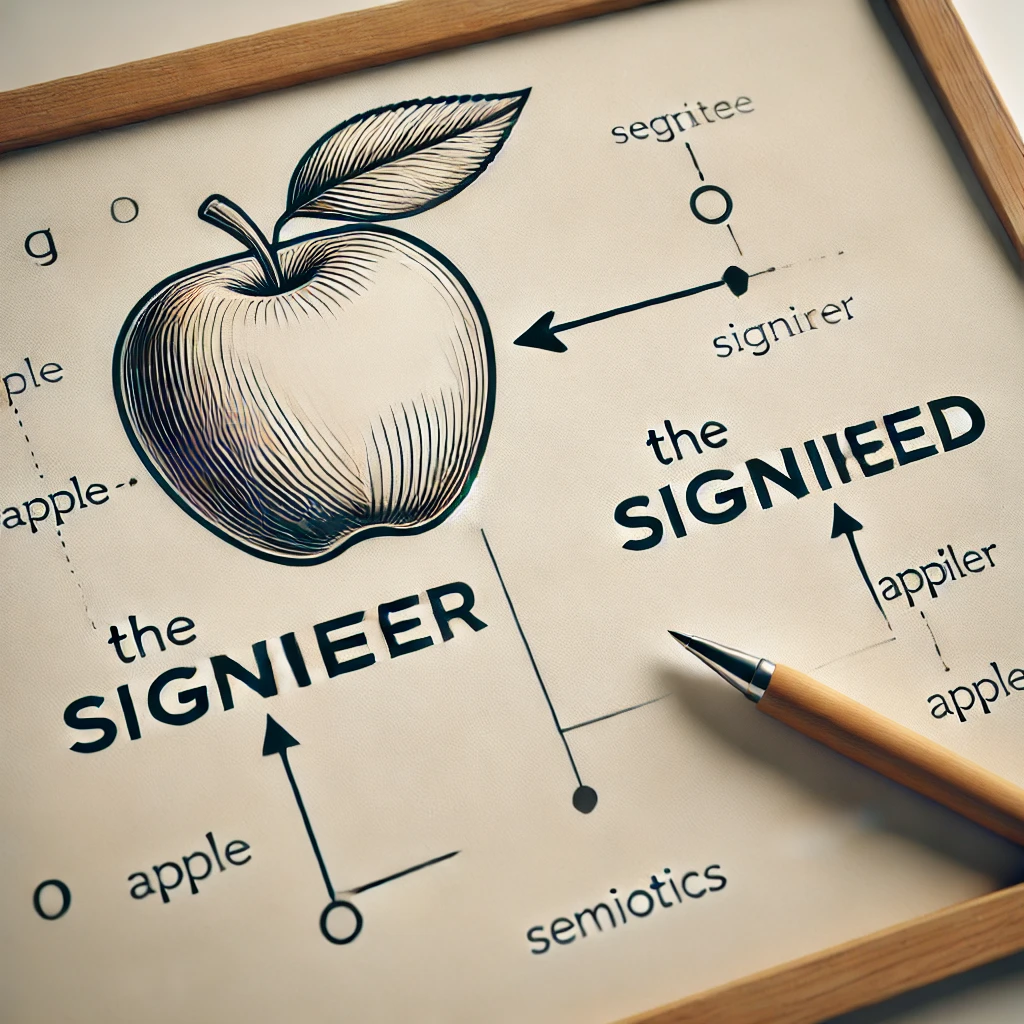
Podcast Summary: Breaking Free from Syntax Locking – The Future of Knowledge Representation
In this thought-provoking podcast, the discussion revolves around semiotics, syntax locking, and the evolution of knowledge representation. The conversation starts with an exploration of semiotics—the study of signs and symbols—and how meaning is traditionally interpreted through signifier-signified relationships. However, the central argument challenges the idea that all meaning must be mediated through signs, suggesting instead that a new framework is needed—one that moves beyond syntax and directly represents conceptual models.
The Problem of Syntax Locking
A key insight introduced in the discussion is syntax locking, a term that currently lacks mainstream recognition but represents a critical flaw in how we encode and share knowledge. Syntax locking occurs when meaning is trapped within a specific sign system, requiring interpretation through a rigid structure of signs and symbols. This problem is exacerbated by modern technologies, including Large Language Models (LLMs), which flood the world with exponentially more syntax-locked content rather than freeing knowledge from these constraints.
The Business Rule Completeness Conjecture (BRCC)
To counteract syntax locking, the speaker introduces the Business Rule Completeness Conjecture (BRCC), which posits that all conceptual models can be fully and unambiguously captured using five simple data modeling primitives:
-
Schema – The structural framework that defines entities and their relationships.
-
Static Data – Immutable, always-true facts that exist independently of language.
-
Lookups – Connections between entities that provide relational context.
-
Rollups – Aggregations that summarize and extract insights from structured data.
-
Calculated Fields – Dynamic values derived from existing data and rules.
This syntax-free approach creates a mirror of reality rather than an interpretation mediated by signs. It allows knowledge to be modeled in a universal, structure-based way, independent of language or syntax.
The Tower of Babel as a Metaphor
A powerful analogy is drawn between the Biblical story of the Tower of Babel and modern syntax-locked systems. The tower itself—a shared conceptual model—remained intact, yet people became divided because their syntax-dependent sign systems no longer allowed them to communicate effectively. This mirrors today’s fragmentation in programming languages, data formats, and human languages, where knowledge remains siloed and locked within incompatible syntaxes.
In a BRCC-compliant world, the “tower” of knowledge remains universally understandable, enabling all systems and people to “look up” and recognize the same truth, free from the constraints of syntax.
Flatland and the Dimensional Shift
A fascinating thought experiment is introduced through Flatland, where a two-dimensional being (Square) perceives a three-dimensional sphere only through sequential “slices.” This represents the fundamental limitation of one-dimensional sign-based communication—meaning must be decomposed into a series of symbols and then reassembled with great cognitive effort. However, when Square enters Spaceland (three dimensions), he perceives the sphere instantly, in its entirety, without requiring a serialized description.
This metaphor perfectly encapsulates the difference between syntax-locked systems (Flatland) and syntax-free conceptual models (Spaceland). In a BRCC-compliant system, ideas are grasped instantly, without needing to be broken down into sequences of signs. This shift allows knowledge to be stored, shared, and understood directly, rather than through slow, lossy translation.
The Call to Action: Freeing Knowledge from Syntax
The podcast closes with a call to action: the urgent need to lift centuries of knowledge out of its syntax lockchains and into syntax-free, universally accessible formats. This means:
-
Recognizing syntax locking as a fundamental limitation.
-
Shifting focus from syntax-based representation to directly structured, syntax-free conceptual models.
-
Updating frameworks like the Semantic Web to incorporate all five BRCC primitives, making knowledge representation truly universal.
-
Understanding that enterprise software must be judged by whether it aligns with a universal, rule-based conceptual model—not just whether it functions within a given syntax.
Final Thought
The discussion leaves us with a profound conclusion: syntax is necessary for expression, but it should never be the source of truth. Just as the Tower of Babel remained standing despite linguistic fragmentation, the conceptual structures of reality exist beyond the limitations of syntax. The future of knowledge lies not in refining syntax but in transcending it—replacing syntax-locked systems with a universal, conceptual mirror of meaning.
This podcast challenges linguistics, semiotics, and modern computing paradigms and presents a bold vision for the future—one where knowledge is free from the chains of syntax and universally accessible to all.